Southside Chicago: What Institutional Alignment Looks Like

Southside Chicago is home to the University of Chicago, the neighborhood’s largest private employer and the second-largest employer in the city. Its endowment sits at $10.9 billion. A few blocks away, in Woodlawn, the median household income is $41,111.
That gap isn’t new, and it’s not an accident. It’s what happens when an institution grows in a neighborhood without ever being built to grow the neighborhood with it.
For five months, we’ve traced this same failure through different rooms: housing dropped into places without the income to support it, jobs added before the conditions exist to hold them, schools structured to struggle before the doors even open. Different room, same problem, every time.
This month, we’re naming the condition tying it all together. Not a task force. Not another MOU sitting in a government drawer somewhere. Something the South Side has almost never actually had.
It’s called institutional alignment.
What Is Institutional Alignment?
Institutional alignment is when the incentive structures, funding timelines, and accountability frameworks of different systems are built to depend on each other’s success. Not cooperation. Dependency.
That distinction shows up fast once you look for it:
- A school that can’t point to the neighborhood’s conditions as part of its own performance measure isn’t aligned.
- A housing agency that doesn’t track whether residents can actually sustain themselves five years later isn’t aligned.
- A workforce program that stops measuring the moment someone gets placed isn’t aligned.
Each one of those can hit every target it’s got and still leave the neighborhood exactly where it started. That gap is what institutional alignment is supposed to close.
The Church That Never Left
There’s one institution on the South Side that was never built to walk away. When schools failed, the church ran the tutoring program. When healthcare was out of reach, it organized the health fair. When the jobs disappeared, it became the informal employment network nobody officially ever set up.
The church didn’t fill those gaps because it was asked to. It filled them because nothing else did.
So here’s the real question: what does it mean to ask a community anchor that’s already absorbed decades of institutional failure to now sit at the table as a “partner,” alongside the very systems that created the gaps it’s been covering? If the rest of these systems were serious about alignment, the church wouldn’t be a partner in the conversation. It would be the measuring stick for how far behind everyone else still is.
What the Sequence Actually Requires
None of this is complicated in theory. It’s a chain:
- A school stabilizes.
- Families start reconsidering the neighborhood.
- That consideration creates activity.
- Activity builds a commercial environment.
- A commercial environment creates local jobs.
- Local jobs keep income inside the community.
- Income inside the community creates a real market.
- A real market is the only place certain kinds of development actually work.
Pull one link out and the whole thing collapses. That’s how you end up with a housing development with no market to support it, a job training program pointed at jobs that don’t exist locally, or a school surrounded by conditions working against everything it’s trying to do.
Understanding Isn’t the Problem
Most people working in development, governance, and community investment already understand this sequence. That was never the missing piece.
The real question is whether the systems they work inside were ever built to require it. On the South Side, most weren’t. That’s the condition that’s been missing the whole time.
What Institutional Alignment Is Not
Now that we’ve named what institutional alignment actually is, it’s worth being just as precise about what it isn’t. Communities everywhere have been sold every version of the imitation.
It isn’t a task force. It isn’t a coalition with a signed memorandum of understanding. It isn’t three institutions sharing a stage at a press conference, saying “partnership” into a microphone while their incentive structures keep pointing in three completely different directions.
That happens constantly, in Chicago, in Detroit, in Baltimore, in every city with a distressed neighborhood and a development agenda sitting on someone’s desk. And the zip codes don’t move.
Real alignment requires something most institutional structures were never built to produce:
- Incentives aimed at the same outcome, not just parked in the same geography
- Timelines that account for each other instead of running on separate clocks
- Accountability that doesn’t dissolve the moment a grant cycle ends
The structure itself has to produce coordination. It can’t depend on goodwill, good intentions, or a shared vision statement to hold it together, because none of those survive a change in leadership or a bad budget year.
Alignment is when the structure forces the same outcome whether people agree or not. What people usually think is alignment is something much simpler: proximity. Institutions operating in the same neighborhood, mistaking that for coordination.
Why Misalignment Is the Default on the South Side
Misalignment isn’t a failure of effort or a failure of any single institution. It’s the predictable result of every system measuring its own performance in isolation.
Here’s what that actually looks like:
- A school district gets funded based on test scores, not on whether the neighborhood around it is economically viable.
- A housing agency counts units delivered, not whether the residents who moved in can still afford to stay five years later.
- A workforce program measures job placements, not whether those jobs kept income circulating in the community or sent it somewhere else every evening.
Every one of those institutions can hit every target on its own scorecard, and the neighborhood can still lose. Nobody in that picture is technically failing. They were just never required to succeed together in the first place.
This isn’t bad actors, and it isn’t people not trying. The incentive built into most of these systems is simple: run your function, report your numbers, protect your funding. Coordination was never part of the design. So the default becomes every institution optimizing for itself.
Everyone at the table walks away winning. The community is the only one that loses.
That’s not accidental. It’s exactly what independent accountability structures produce when you put them in the same neighborhood without ever requiring them to depend on each other, which is precisely the pattern the South Side has been living inside for decades.
Why Institutions Can Thrive on the South Side of Chicago While the Neighborhood Doesn’t
The South Side isn’t a special case. It’s just the clearest example of a pattern showing up in underinvested neighborhoods across the country.
Start with what’s already sitting a few blocks apart from each other: the University of Chicago’s $10.9 billion endowment, and a median household income of $41,111 in Woodlawn. Those two numbers have coexisted in the same geography for decades, and neither one moved the other.

Major hospital systems employ tens of thousands of people across the South Side of Chicago. Most of those workers commute in every morning and take their wages home every evening.
Cultural institutions, city agencies, faith organizations: many have operated on the South Side for generations. Most measure their own success by their own output. Very few measure the neighborhood around them.
None of this is about pointing a finger at any one institution. It’s a pattern that shows up in nearly every underinvested urban community in the country. Institutions arrive. Institutions grow. Institutions build their own sustainability. And the neighborhood around them stays structurally dependent, because nobody ever designed those institutions to require the neighborhood’s self-sufficiency as a condition of their own success.
The South Side is one of the clearest, most visible versions of that pattern, not the only one. There are neighborhoods like it in every major American city. Some bigger, some smaller, all carrying the same contradiction: full of institutional presence, still not economically self-sufficient, because the institutions were never built to produce that outcome together.
Presence isn’t investment. Longevity isn’t impact. You can fill a neighborhood with institutions for hundreds of years and still leave it structurally dependent.
Why Hasn’t Institutional Alignment Been Built on the South Side of Chicago?
Alignment hasn’t been built because it’s nearly impossible to fund, not because nobody wants it.
Here’s the problem: alignment isn’t a program. It’s a condition. There’s no deliverable to photograph, no unit count for a quarterly report, no placement number anyone can put in a slide deck. The outcome is a neighborhood shifting over years, and that timeline runs well past the political cycles controlling most of the funding that could support it.
What gets funded is what can be announced. What gets announced is what can be seen:
- Units built
- Placements made
- Ribbons cut
The condition that would actually make those things work together doesn’t produce a press release on any given Tuesday. So it doesn’t get funded, and it doesn’t get built.
Real alignment would also require something most institutions aren’t structured to give: shared accountability, which means shared credit and shared risk. The funding mechanisms backing these systems aren’t designed to reward that. The governance overseeing them isn’t built to measure it. So alignment gets talked about in meetings and never actually built. Not because nobody wants it, but because nothing in the system currently requires it.
Here’s the honest version, stripped down: this was never an alignment problem. It’s an incentive problem. Fix the incentives, and alignment becomes possible. Leave them exactly as they are, and alignment stays something institutions describe on a panel and skip in practice.
What Would Real Institutional Alignment Require on the South Side of Chicago?
Real institutional alignment would require three different groups to change how they operate, not just one.
Institutions would have to answer a different question than the one they’re used to. Not whether they support the neighborhood, most already believe they do. The real question is whether their definition of success requires anything of the neighborhood around them, and whether that neighborhood’s condition shows up anywhere in how they measure their own performance.
Governance would have to stop measuring development by outputs and start measuring whether the underlying conditions are actually shifting. That means funding coordination between systems, not just individual programs sitting in the same geography and calling that a portfolio. The accountability structures that currently let every institution report success while the neighborhood declines would have to change too.
Communities would have to learn to see a distinction that isn’t always visible from the outside: the difference between an institution designing toward a neighborhood’s self-sufficiency, and one designing toward its own continued presence. Same with the difference between real coordination and just shared geography. Knowing that distinction exists is the first step toward asking for something more specific than what usually gets offered.
Underneath all three is one question every institution on the South Side of Chicago can be asked directly:
What does your success require the neighborhood around you to look like?
If the answer is nothing, that’s the answer.
What Institutional Alignment Would Mean for Woodlawn
Housing needs income. Income needs employment local enough to keep wages inside the community. Employment needs an environment that can actually support it: schools people trust, streets you can walk, and visible signs that things are moving in the right direction. All of it needs institutions whose success depends on each other instead of running on separate tracks.
None of that is complicated. It’s been sitting in plain sight for a long time. What’s been missing isn’t the insight. What’s been missing is the condition that would require anyone to act on it.
That condition has a name. Institutional alignment. It’s been described in report after report and built almost nowhere.
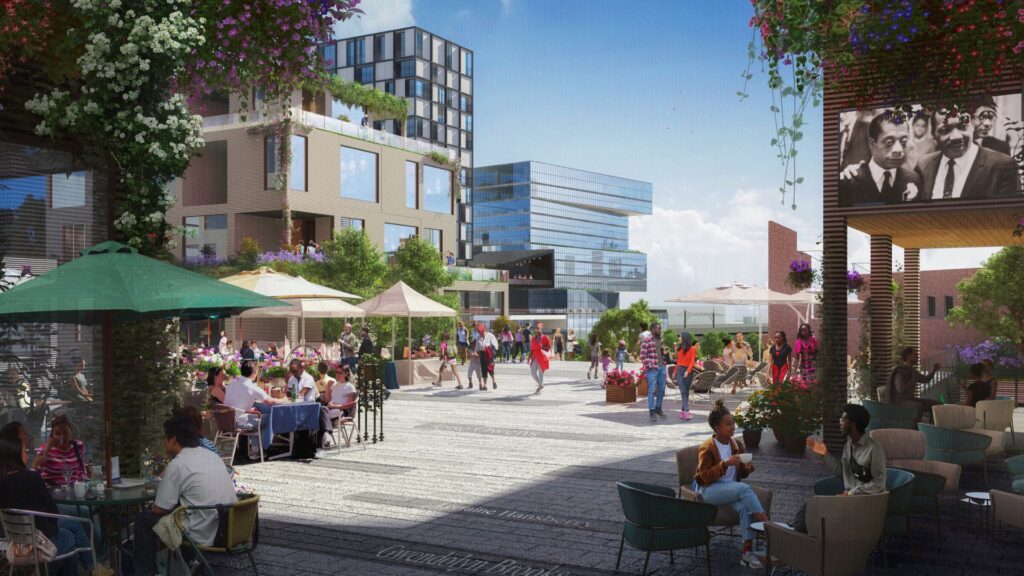
This is where Woodlawn Central starts from a different premise. We’re not waiting on the University of Chicago, city agencies, or hospital systems to redesign their incentives around this neighborhood. We’re building the institutions ourselves; housing, retail, jobs, culture, under one plan, so the alignment isn’t something we have to ask for later. It’s built into the foundation from day one.
That’s the difference between a neighborhood full of institutions and a neighborhood built by one plan that requires all of it to work together.
Rooted. Reclaimed. Ours.
Explore the latest news, community highlights, development updates, and impactful stories shaping the future of Woodlawn Central and Chicago’s South Side.

Woodlawn's News & Announcements

connect
South Side Soundtrack
Our Community ● Our Community ● Our Community ● Our Community ● Our Community ● Our Community ● Our Community ● Our Community ● Our Community ●


