
Why Public Funding Takes So Long to Reach Black Communities
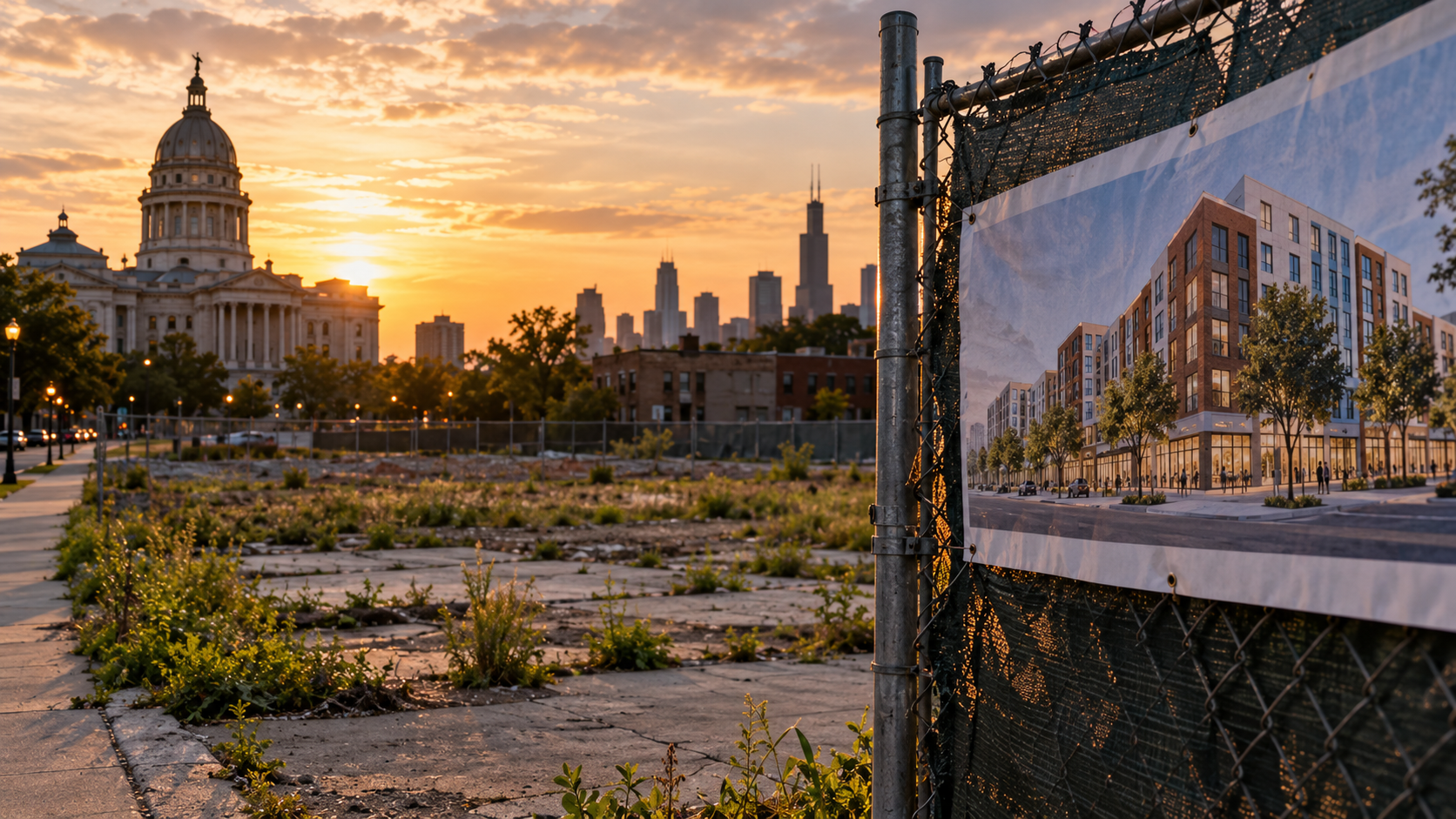
Ask anybody who grew up on the South Side. We’ve heard the promises. New housing. New jobs. New stores. We’ve seen the renderings on the easel at the community meeting. What we usually don’t see, for years, is anything actually built.
In Black communities, getting money promised is rarely the hard part. Waiting for it to show up is.
Here’s a real example. In March 2024, the City of Chicago picked 13 affordable housing projects to receive public money. Thirty months later, in September 2026, only two of them had started construction.
That’s not one bad funding round. It’s a pattern Black communities have lived inside for decades. Public money has to pass through a long chain of steps before anything gets built, and our neighborhoods usually have to go through more of those steps than others. Every extra step adds months. And while the money sits, rent goes up, building costs go up, and our people get pushed out.
To understand why, you have to start with what public funding actually is.
What Is Public Funding?
Public funding, also called government funding, is money from the federal government, the state, or the city. It pays for what a neighborhood needs to grow, like affordable apartments, new stores, job programs, and parks.
In Black neighborhoods like Woodlawn, public funding matters even more. For generations, banks and private investors have kept their money off our blocks. Without public money, a lot of what we need never gets built at all.
The most common kind of public funding for affordable housing is called a Low-Income Housing Tax Credit. Here’s how it works:
- The government gives a builder (called a developer) tax credits.
- The developer sells those credits to a bank or large company.
- The company gets to pay less in taxes. The developer gets cash to build.
- In exchange, the apartments have to stay affordable for at least 30 years.
How Does Public Funding Get From City Hall to Your Block?
Most of us only hear about a project twice: at the big announcement, and years later, at the ribbon cutting. Nobody explains what happens in between. That’s where the time goes. Here’s the path a typical affordable housing project has to walk:
- The government sets aside money: Federal tax credits are split up among the states. Chicago is one of only two cities in the country, along with New York, that gets its own share.
- Developers apply: Builders send the city their plans and budgets and compete for the money.
- The city picks winners: This is the big announcement. For most neighbors, it’s the first time they hear about the project.
- The developer hunts for the rest of the money: Tax credits almost never pay for a whole building. On average, an affordable housing project needs 3.5 different sources of money, and 1 in 4 projects need five or more. Each one has its own forms, rules, and deadlines.
- The city reviews everything: The project has to pass money checks, design review, zoning, and a City Council vote. (Zoning is the set of rules about what can be built where.)
- The deal closes: Every group putting in money signs at the same time. Chicago expected this to take 18 to 36 months after the announcement.
- Construction starts: Fences go up, crews show up, and for the first time neighbors can actually see something happening. Building can take another year or more, and rising costs or supply delays can still slow things down.
- Families move in: People apply, get approved based on their income, and finally get their keys. This is the only step that actually changes someone’s life, and it’s the one that almost never makes the news.
Every extra source of money makes that gap longer. Researchers at UC Berkeley studied affordable housing in California and found that each extra source of public money added about four months and about $20,000 per apartment.
The more pieces a project needs, the longer the neighborhood waits.
Why Does Public Funding Take Even Longer in Black Communities?
That process is slow everywhere. It’s slowest on our blocks. And it’s not because we ask for too much. It’s because private money has stayed away from Black neighborhoods for generations, so our projects need more pieces of public money to fill the gap.
Banks Lend Less in Black Neighborhoods
When banks lend money, a project can borrow part of what it needs. When banks don’t lend, that part has to be covered with public money instead.
Reporters at WBEZ and City Bureau looked at every home loan made in Chicago from 2012 to 2018. They found that for every $1 banks lent in white neighborhoods, they lent just 12 cents in Black neighborhoods. Banks put more money into Lincoln Park alone than into every majority-Black neighborhood in Chicago combined.
Homes in Black Neighborhoods Are Valued Lower
Banks decide how much to lend based on what a property is worth. A study by the Brookings Institution found that homes in majority-Black neighborhoods are valued 23% lower than similar homes in neighborhoods with few or no Black residents. Same kind of house. Same kind of neighborhood features. On average, that’s $48,000 less per home.
Lower values mean smaller loans. Smaller loans mean bigger gaps to fill.
More Gaps Mean More Steps, and More Steps Mean More Years
Here’s how it adds up:
- Banks lend less, so more of the project has to be paid for with public money.
- Property is valued lower, so the project can borrow less.
- That means the project needs more separate sources of public money.
- Each extra source adds months and adds cost.
We don’t wait longer because we ask for more. We wait longer because the system makes our projects harder to pay for.
Has Chicago Kept Its Promises to Black Neighborhoods?
This isn’t new. Here are three big promises the city made to the South and West Sides, and what actually happened.
| The promise | When | What was promised | What actually happened |
| Woodlawn Housing Preservation Ordinance, a city law to keep Woodlawn residents from being pushed out near the Obama Presidential Center | September 2020 | 52 empty city-owned lots for affordable housing, plus seven programs to help renters and homeowners stay | After five years, one 58-unit building was finished and three of the seven programs never started |
| INVEST South/West | October 2019 | More than $750 million in public money for 10 South and West Side neighborhoods | The first project to close didn’t break ground until January 2023, more than three years later |
| Housing and Economic Development Bond, money the city borrows to pay for housing and business projects | April 2024 | $1.25 billion over five years | Fourteen months later, in June 2025, the city borrowed its first $82.5 million |
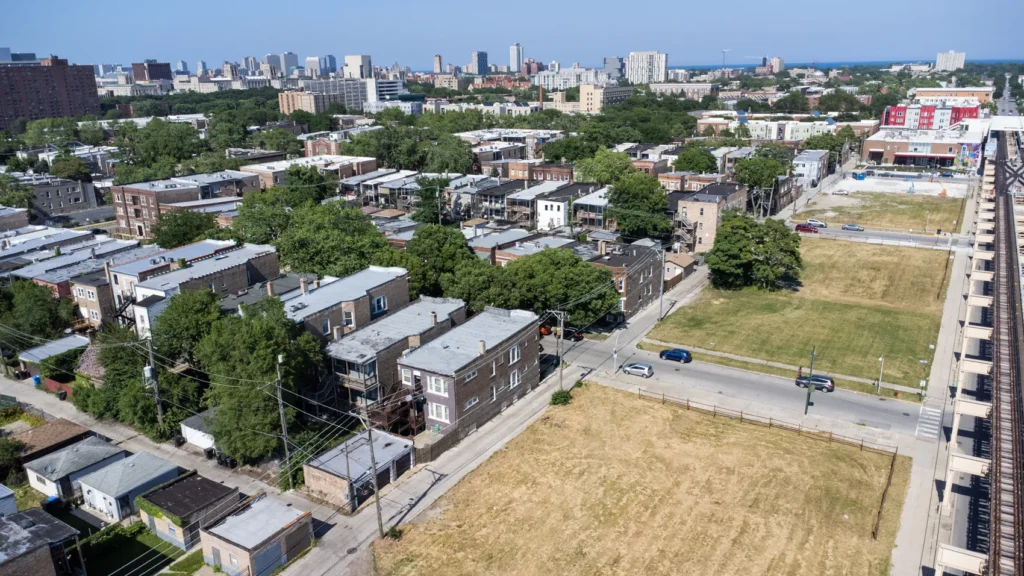
The Woodlawn law hits closest to home. Neighbors organized for years to win it, but reporters also found that about $2 million set aside under the law was never spent.
While we waited, Woodlawn kept changing. Rents and home prices went up, and many of the neighbors the law was meant to protect were left wondering whether they could still afford to stay in their own neighborhood.
Our neighbors did their part. They organized, they showed up, and they won. The problem was never the people. It was the speed.
Help that arrives after people have already been pushed out isn’t much help at all.
What Happens to a Neighborhood While It Waits?
A delay is never just a delay. Every year a project sits still, our neighborhood pays the price.
The Same Money Builds Fewer Homes
Building costs keep rising while the paperwork moves. One Chicago project, Hub 32 in Garfield Park, was expected to cost about $732,000 per apartment in 2023. By February 2026, that was about $796,000. As of 2026, building one affordable apartment in Chicago costs more than $700,000. When a project waits, the same amount of public money builds fewer homes.
Rent and Home Prices Go Up
While Woodlawn waited for its protections, prices climbed. DePaul University found that the typical home price in East Woodlawn doubled between 2019 and 2025, reaching $440,000. Rent for a one-bedroom went from about $1,200 to about $1,800. By the time affordable housing arrives, the neighborhood may already cost too much for the people it was meant to help.
Our People Move Away
Chicago lost about 85,000 Black residents from 2010 to 2020. That’s almost 1 out of every 10 Black Chicagoans. A University of Illinois Chicago report found the neighborhoods that lost the most people were the same ones where schools and public housing closed. When help doesn’t come, families go where they can build a life.
Jobs Don’t Come
A stalled project also means no construction jobs, no new stores, and no new hiring. That hurts most where jobs are already hard to find. In September 2026, the unemployment rate for Black workers nationwide jumped from 6% to 7%, the highest of any major group. In Chicago, 46.5% of Black young adults ages 20 to 24 had no job in 2024. That’s more than twice the rate for young white adults.
Late money costs more, buys less, and often shows up after the people it was meant for are gone.
How Can Black Communities Speed Up Public Funding?
We can’t make the government move faster by wishing. But a lot of the wait comes from steps a community can own, control, or push on. Here’s how we take back the clock.
1. Own the Land Before the Money Comes
Buying land is one of the slowest steps in any project. Even the city has worked to speed it up. Through its “Cut the Tape” program, Chicago cut the time it takes to price city-owned land from six months to one month. A community that already owns its land can skip this step completely.
2. Push the City to Speed Up Affordable Housing Approvals
Cut the Tape has made some city approvals faster. For example, the city’s Plan Commission cut its review time from 135 days to 79 days. But affordable housing builders say those changes haven’t reached their projects yet. One said their project wouldn’t start construction until nearly three years after applying for tax credits. Residents can ask their alderman and the city to make affordable housing approvals a priority.
3. Ask for Simpler Funding, Not Just More Funding
If every extra source of money adds months, the fix isn’t only more money. It’s simpler money. UC Berkeley researchers recommend combining funding programs so projects can get the same amount from fewer sources, with deadlines that line up.
4. Bring In Lenders Built for Black Neighborhoods
Some lenders exist to lend where big banks won’t. They’re called Community Development Financial Institutions, or CDFIs, and they include community loan funds and credit unions. Bringing them into a project early can fill gaps that would otherwise wait on another round of public money.
5. Get Residents Ready While the Money Moves
The waiting years don’t have to be wasted. Residents can train for the construction, hotel, and retail jobs that are coming. Families can build credit and savings to buy a home. Local business owners can get ready to rent a storefront and hire staff. That way, when the doors open, the people who’ve been here all along are first in line, not last.
6. Follow the Money
The city’s $1.25 billion bond law requires every project it pays for to be posted online, and the city’s housing and planning departments have to report on it every three months. Those reports only help if people read them.
Local elections matter too. Your alderman has a big say over zoning and city funding in your ward. But in Chicago’s February 2023 city election, only 35.85% of voters turned out, compared with about 67.9% in the 2024 presidential election. The people who decide what gets built on our blocks are chosen by the fewest of us.
Nobody’s going to hand us speed. We build it into the plan ourselves, from day one.
Frequently Asked Questions
Is public funding the same as government funding?
Yes. Both mean money that comes from the federal, state, or city government, instead of from private banks or investors. It can come as grants, loans, tax credits, or tax breaks.
What’s the difference between 9% and 4% housing tax credits?
Both are tax credits for affordable housing. 9% credits are bigger and harder to win, because developers compete for them. 4% credits are smaller and come paired with special government bonds, so projects using them usually need even more funding sources. In its 2023 round, Chicago gave out about $13 million in 9% credits and $11 million in 4% credits.
What does area median income (AMI) mean?
AMI is the middle household income for a whole region, set each year by the federal government. Affordable housing uses it to decide who qualifies. For example, if the AMI for a family of four were $100,000, an apartment set at 50% AMI would be for a family of four earning $50,000 or less. Because Chicago’s AMI includes wealthier suburbs, apartments called “affordable” can still cost too much for many South Side families.
What is TIF?
TIF stands for Tax Increment Financing. When property values in an area go up, the extra property tax money gets set aside to pay for projects in that same area. Chicago uses TIF more than almost any city. It made up about 16% of the property taxes collected in Chicago, around $1.3 billion, in 2022.
How can I find out what’s being funded near me?
The Chicago Department of Housing posts reports every three months on which projects got money, got approved, and started building. In Woodlawn, the city brought back the Woodlawn Working Group in 2026 to keep an eye on the housing law. Its meetings are a good place to ask where projects stand.
How can I get involved with Woodlawn Central?
You can join the waitlist to be first in line for homes and space, sign up for the newsletter for updates on the build, or share your story to be featured.
What’s Next for Woodlawn Chicago
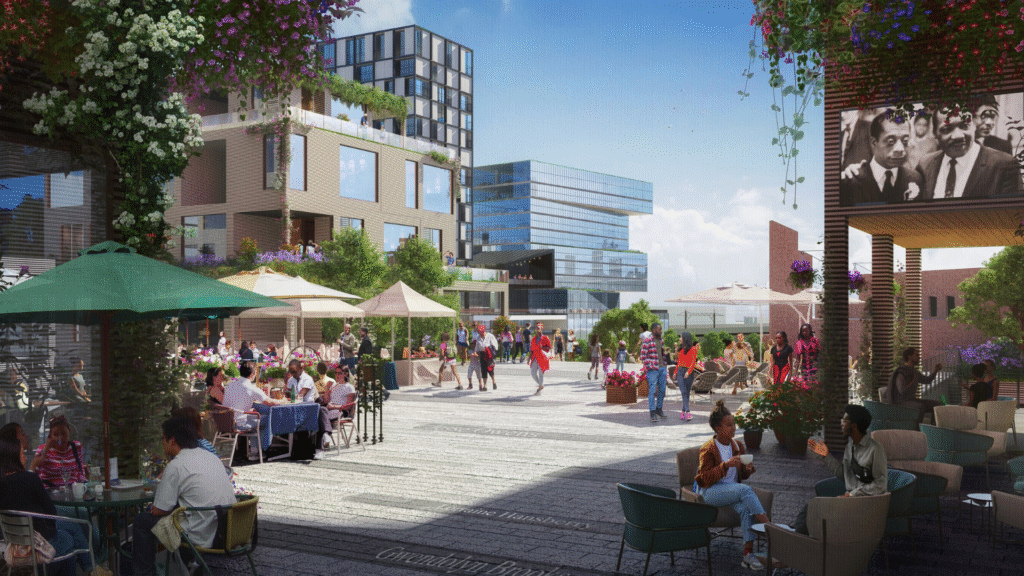
Woodlawn Central was built for this exact problem. Not to sit around waiting on the system, but to be ready when it finally moves. Here’s how.
The land is already ours. The Apostolic Church of God has owned this land for more than 50 years and has promised never to sell it. That means no waiting to buy land, and no outside owner who can walk away.
Residents set the rules early. Since 2021, neighbors have shared what they want at community meetings. What they asked for is written into Woodlawn Central’s agreement with the city:
- 20% of the homes must be affordable
- Black-owned and local businesses get priority over national chains
- One, two, and three-bedroom homes for families already here, with senior and multigenerational housing coming later
It’s built to create jobs, not just buildings. Plans include a hotel, a black box theater (a small, flexible performance space), a vertical greenhouse (an indoor farm that grows food in stacked layers), a food market, and space for local businesses. These create jobs and income for the neighborhood long after opening day.
None of this makes government money move faster by itself. But when the money lands, Woodlawn will be ready to put it to work right away. Not five years later. Not after our people are gone.
Public funding that shows up late, after families have been priced out, is a missed chance. Public funding that shows up to a community that owns its land, wrote its own terms, and got its people ready? That’s how you build a legacy. Built by us. Backed by us.
Rooted. Reclaimed. Ours.
Explore the latest news, community highlights, development updates, and impactful stories shaping the future of Woodlawn Central and Chicago’s South Side.

Woodlawn's News & Announcements

connect
South Side Soundtrack
Our Community ● Our Community ● Our Community ● Our Community ● Our Community ● Our Community ● Our Community ● Our Community ● Our Community ●


