Why Chicago’s South Side Housing Market Can’t Grow Without Economic Mobility
February 20, 2026
People talk about the South Side and low-income communities like it’s a mystery. Like the gap between property values here and property values in Lincoln Park or Wicker Park is just supply and demand doing its thing, nothing to see. They reflect the decisions that were made upstream: who got loans and who got redlined, which neighborhoods got infrastructure investment and which got expressways built through them, which communities got connected to jobs and which got cut off.
The South Side’s housing market is exactly what decades of deliberate disinvestment produces. Sustained growth that truly benefits current residents is impossible unless we first tackle the underlying crisis of economic mobility.
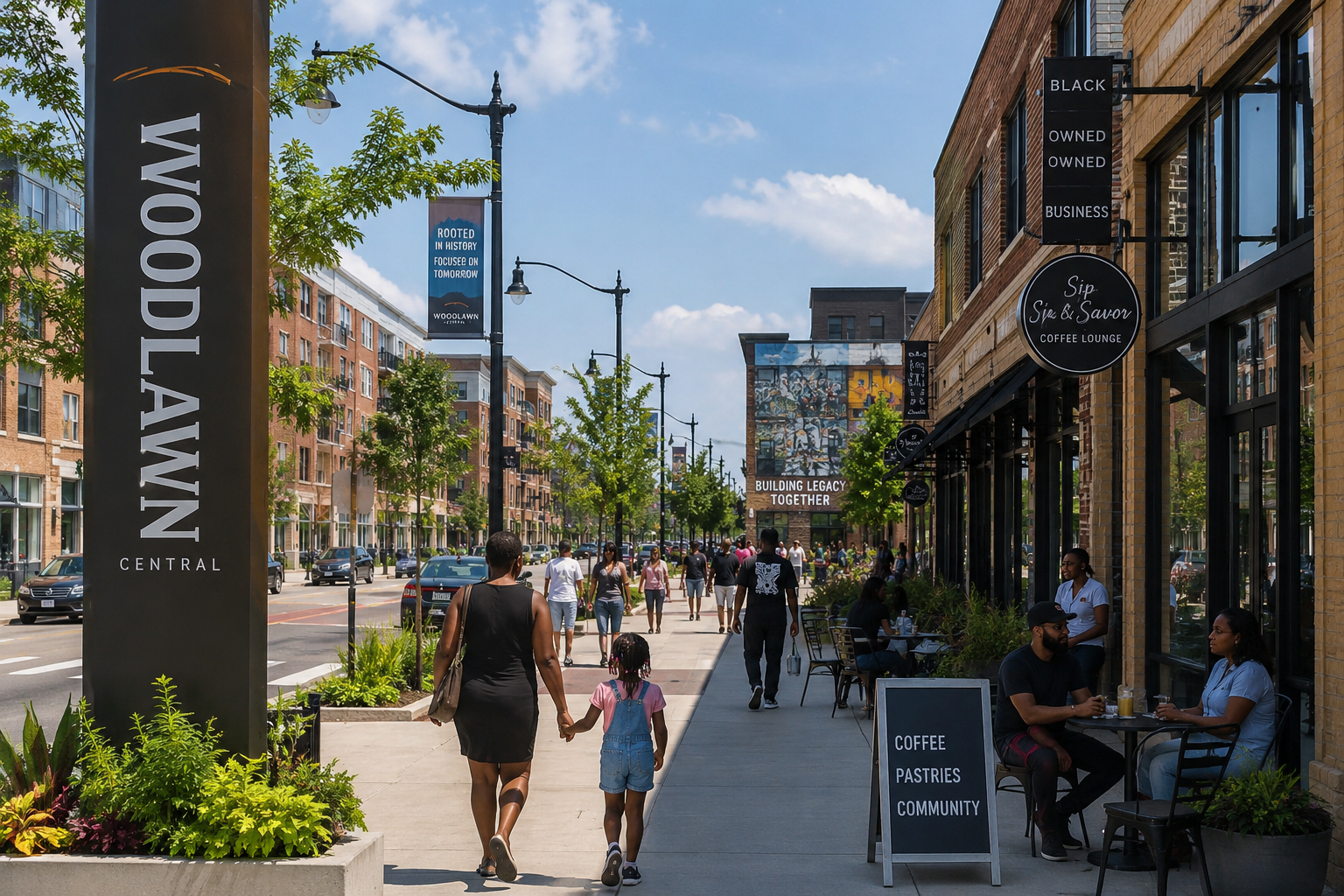
That’s what Woodlawn Central was built to do. Not to gentrify from the outside in. Growth springs from within, deeply rooted in the current residents who are the bedrock of this community. They are already building and holding it together through sheer determination, often with insufficient resources.
What We Mean When We Say Economic Stability
Economic mobility is the ability to move up and earn more than the generations before you did. The ultimate goal is to build wealth over time, not just survive paycheck to paycheck. It means having a realistic shot at homeownership, at saving, at sending your kids to college without devastating debt, at retiring with something to pass on.
For Black families on Chicago’s South Side, that shot has been systematically blocked for low income communities About 43% of Woodlawn’s Community the median household income is approximately less than $25,000 a year. compared to the city of Chicago making up about 19% of the lower income households. That gap isn’t a coincidence. It’s the compound interest of over a century of exclusion.
Research from the Brookings Institution shows that Black Americans have significantly lower rates of upward economic mobility than white Americans, even when controlling for income level at birth. This means the system itself is the barrier, not just starting conditions.
On the South Side, that national pattern plays out block by block. And it has a direct, measurable effect on low income communities..
The Income that the South Side Housing Market Needs
Here’s the basic mechanics:
- Growing Housing Markets: Requires people to have enough income to participate.
- Income Participation Includes:
- Paying rent reliably.
- Qualifying for a mortgage.
- Investing in real estate development (repairs, improvements, basic maintenance).
- The Impact of Suppressed Incomes: When incomes are suppressed at the neighborhood level, the entire Chicago housing market loses its floor, leading to property value decline.
78% Woodlawn residents are renters, limiting wealth-building through homeownership.
38% homeownership gap between Black and white residents in Chicago.
This is the cycle. Low income communities suppress demand. Suppressed demand keeps property values down. Low property values reduce the tax base that funds schools and infrastructure. Therefore, this keeps property values low. This reduces the tax money available for schools and infrastructure. The people who love this neighborhood, who are rooted here, are the ones left holding the bag of a market that has been intentionally depressed around them.
How Redlining’s Financial Legacy Still Shapes Today’s Real Estate Development
The South Side’s economic mobility crisis didn’t start last decade. It has roots that go back generations. More explicitly, to the federal redlining maps of the 1930s and 1940s, which designated Black neighborhoods as “hazardous” for mortgage lending and effectively shut out an entire generation from the wealth-building engine of homeownership.
A 2018 investigation by the National Community Reinvestment Coalition found that 3 out of 4 neighborhoods redlined by the federal government in the 1930s remain low-to-moderate income today, and the majority are still disproportionately nonwhite.
The overlap between historically redlined areas and today’s lowest-income and homeownership neighborhoods is not coincidental. The housing market on the South Side cannot grow in isolation from this history. Any strategy that ignores it is a strategy that will fail the people who need it most.
What Economic Mobility Actually Unlocks in the Housing Market
When income rises in a neighborhood and residents have more to spend and more to save, low income communities respond positively. For instance, property investment increases, homeownership becomes more accessible, and local businesses get more foot traffic. Landlords face competitive pressure because tenants have more options. In the end, the South Side neighborhood becomes more desirable, not to outside speculators, but to the people already living there.
43% of Black households in Chicago are cost-burdened, spending more than 30% of income on housing.
Economic mobility helps rewire the neighborhood’s market conditions from the ground up, in turn aiding in the economic growth of individual families. Woodlawn hopes to build income and ownership power first and let a genuine, community-rooted housing market grow from that foundation.
The Speculator Problem: When Housing “Grows” Without Economic Stability
There’s a version of South Side housing market growth that we actively reject. It’s the version where property values rise because outside speculators move in. Buying cheap, holding, and then waiting for the neighborhood to “turn”, while the native residents are displaced before they can benefit from a single dollar of that appreciation. Gentrification has affected many low income communities in many ways. For instance, mainly Black, Latino, and other minority communities are seeing a median tax increase of more than 45%, almost a $3,000+ increase in 2023. Gentrification is having a significant impact on the housing market, particularly for minority communities. For instance, communities that are predominantly Black and Latino and other minorities experienced a median tax increase of over 45% in 2023, translating to an increase of more than $3,000.
This is not a hypothetical. Research from the National Bureau of Economic Research and the University of Chicago has documented how speculative investment in undervalued urban neighborhoods consistently precedes displacement of low-income Black residents — a pattern that has repeated across cities including Chicago, Atlanta, Washington D.C., and New Orleans.
When housing market growth is driven by speculation rather than community economic stability, existing residents don’t win. They lose. Their rents go up before their wages do. Their property taxes rise before they have equity to absorb the increase. They get pushed to the margins of a neighborhood whose cultural and social infrastructure they built.
The only real estate development that actually serves the South Side is growth driven by the economic power of the people who are already there. That means job creation and ownership. Wealth that stays in the neighborhood instead of getting extracted by outside investors.
“Development should not trap people in affordability forever. It should create the conditions that allow people to move forward with choice and dignity.”- J. Byron Brazier
What Woodlawn Central is Doing About it
Woodlawn Central is not a housing project with an economic development add-on. It is an integrated strategy that treats homeownership pathways, local hiring, minority business development, and community land trust models as parts of the same engine.
Our approach prioritizes: local hiring and workforce pipelines that connect South Side residents to construction and permanent jobs created by the development itself; commercial space designed for Black-owned and minority businesses rather than national franchise chains. Residents who have been locked out of conventional mortgage markets and community land trust structures prevent future speculation from erasing the gains we build together.
At the heart of the Woodlawn Central project is a vision for inclusive growth. This features diverse business spaces, a 154-room hotel, a black box theater, a vertical greenhouse, and a microgrid energy facility. Every element, from retail and hospitality to culture, tech, and transit, has been thoughtfully crafted to champion Black-owned businesses and bring substantial employment opportunities directly to local residents, ensuring that the people of the community are the first to benefit from this transformative development.
This is what it looks like to build economic stability from the inside out. Not waiting for the market to “discover” the South Side and hoping residents survive the wave. Building the economic foundation that makes the South Side’s housing market work for the people who have built their livelihood here.
The Bottom Line
Chicago’s South Side housing market cannot grow in any meaningful, community-sustaining way without economic mobility for the people who live there. That is not a political position, it’s simply the economic reality of how real estate development functions.
When incomes rise, households can afford to buy. When households buy, neighborhoods stabilize. When neighborhoods stabilize, the conditions for real, lasting housing market growth begin to exist. Woodlawn Central is building that foundation. Block by block. Job by job. Deed by deed. Rooted in the people who have always known what this neighborhood is worth, and who have never needed an outsider to tell them.
The South Side doesn’t need a savior. It just needs to take it’s power back.
That’s what Woodlawn is reclaiming.
Explore the latest news, community highlights, development updates, and impactful stories shaping the future of Woodlawn Central and Chicago’s South Side.

Woodlawn's News & Announcements

connect
South Side Soundtrack
Our Community ● Our Community ● Our Community ● Our Community ● Our Community ● Our Community ● Our Community ● Our Community ● Our Community ●


