How Chicago Development Is Driving Job Creation on the South Side
April 8, 2026
For too long, Chicago’s South Side has watched investment flow elsewhere. Watched cranes rise in the Loop, in the West Loop, in Fulton Market. The community has wondered when it would be their turn. The answer isn’t coming from City Hall alone. It’s coming from within. It’s coming from Woodlawn.
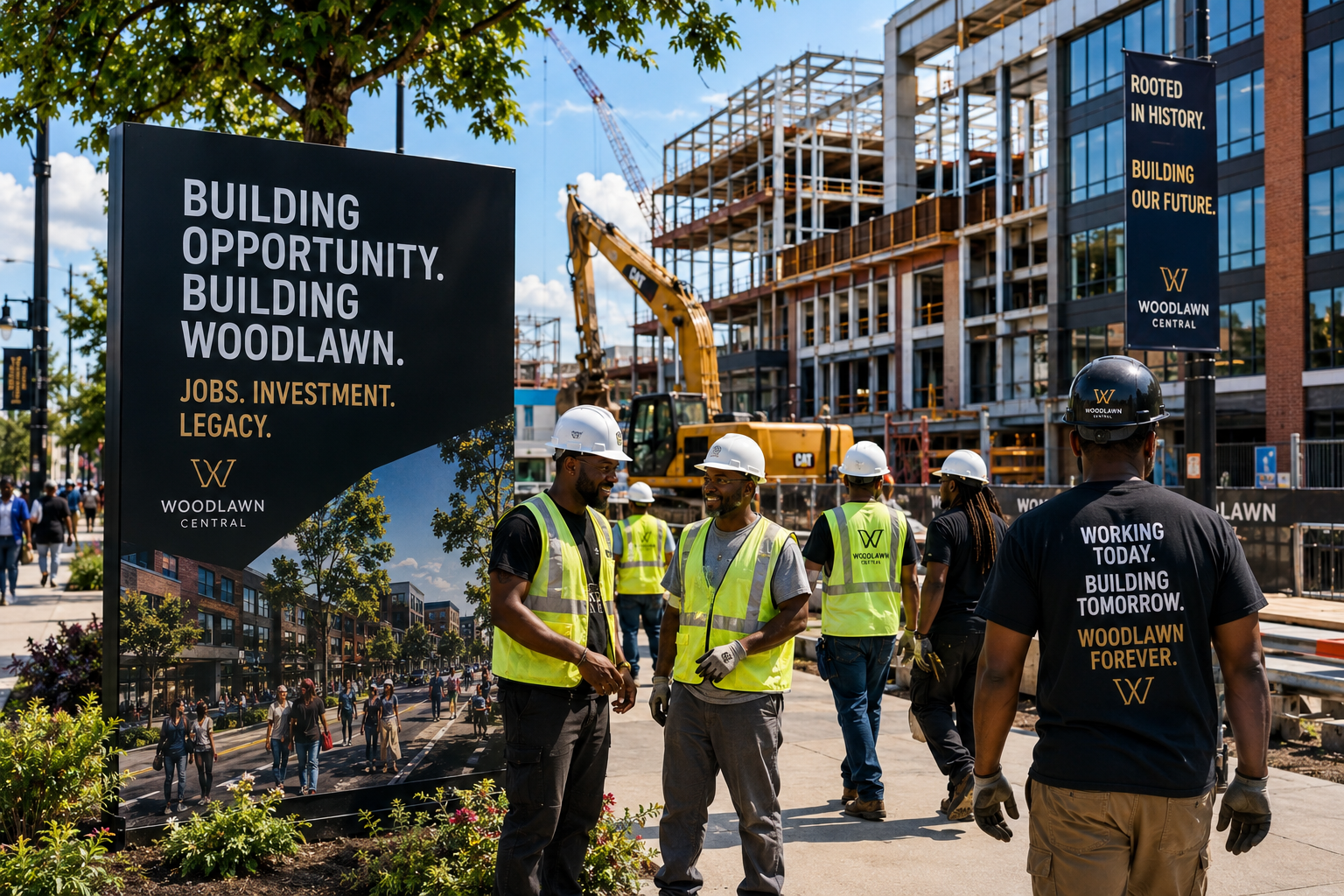
Woodlawn Central isn’t just a Chicago development project. It’s a declaration. A reclamation. And at its core, it’s one of the most ambitious job creation engines this city’s South Side has seen in a generation.
The South Side Has Always Had Power. Now It Has a Plan
Let’s be clear about what’s coming to Woodlawn Ave Chicago, because this isn’t a vague promise or a distant dream. This is a fully realized vision with real spaces, real purpose, and real economic impact.
At the heart of the project is a vision for inclusive growth, featuring diverse commercial spaces, a 154-room hotel, a black box theater, a vertical greenhouse, and a microgrid energy facility. Every element, from retail and hospitality to culture, tech, and transit, has been thoughtfully crafted to champion Black-owned businesses and bring substantial employment opportunities directly to local residents, ensuring that the people of the community are the first to benefit from this transformative development.
Each of these components isn’t just a building. It’s a job. It’s a career. It’s generational wealth with a zip code.
The hotel alone represents dozens of hospitality jobs, from management to maintenance, that don’t require residents to commute hours away from their own neighborhood. The black box theater creates opportunities for artists, technicians, event coordinators, and cultural workers who have always had the talent but rarely had the stage. The vertical greenhouse positions Woodlawn at the forefront of the green economy, an industry that is growing nationally and deserves to take root right here on the South Side.
Chicago Development That Puts Community First
Here’s what makes Woodlawn Central different from every other Chicago development conversation you’ve heard: this project was not designed for outside investors to extract from the community. It was designed by and for the community.
The numbers make the case for why this matters. Black residents make up about 28% of Chicago’s population, yet only 5,606 Black-owned businesses in Chicago were employer firms as of 2021, representing just 2.8% of all employer businesses in the metro area. And nationally, despite Black Americans representing 14.4% of the population, only 2.7% of all businesses with employees were Black-owned in 2021. Meanwhile, Black and Latino residents make up approximately 60% of Chicago’s population but own only 4% (Black) and 9% (Latino) of local businesses.
These aren’t just statistics. They are the result of decades of redlining, disinvestment, and a system that was never designed to let Black wealth compound. Woodlawn Central is built to break that cycle.
When Black-owned businesses thrive, Black workers are hired. When Black workers are hired in their own community, wealth circulates locally. When wealth circulates locally, neighborhoods stabilize, families build, and legacies are made. This is not a theory. This is the economic model Woodlawn Central is putting into practice.
Job Creation Is Not a Side Effect. It’s the Mission.
Woodlawn Central is designed to generate layered, multi-sector employment across every phase of the development: construction jobs now, service and hospitality jobs when the hotel opens, retail and small business jobs as storefronts fill, and tech and green economy jobs through the microgrid and greenhouse.
And here’s why local hiring isn’t just the right thing to do. It’s the necessary thing. Chicago consistently ranks among the top five most segregated cities in America, and Black and Latino residents are more than twice as likely to be unemployed. The economic opportunity being built at Woodlawn Central isn’t meant to be imported from outside the neighborhood. It’s meant to live here, grow here, and stay here.
There is also growing momentum behind Black entrepreneurship that Woodlawn Central is positioned to amplify. More Black small business owners are optimistic about their industry’s future, and about 70% plan to make full-time hires. What they need is infrastructure: physical space, foot traffic, community investment, to make those plans a reality. That is exactly what Woodlawn Central provides.
The Legacy That Makes This Possible
None of this exists without roots. Woodlawn Central draws its strength from the legacy of leaders like Bishop Arthur Brazier, whose lifelong commitment to this community planted seeds that are now bearing fruit. The Brazier family’s vision was never about buildings. It was about people. About dignity. About ensuring that a neighborhood as rich in culture and history as Woodlawn would not be left behind as Chicago evolved.
As far back as 1959, Woodlawn residents organized against injustice, giving birth to The Woodlawn Organization (TWO), which remains a strong and influential presence in the neighborhood to this day. That spirit of community power is embedded in the DNA of Woodlawn Central.
When we talk about job creation on Chicago’s South Side, we are not talking about abstract economic policy. We are talking about honoring the people who held this community together when no one else would. The work being done here is legacy in action.
Why This Moment Cannot Wait
Between 1970 and 1990, several South Side Black communities ranked among the city’s top 30 for median household income. By 2020, only one remained. Many once-middle-class neighborhoods saw median incomes decline by 22% to 47%. That is not a community in decline. That is a community that was systematically stripped of its economic foundation.
The narrative of disinvestment, of deferred promises, of development that serves everyone except the people who actually live there: that narrative ends here.
Woodlawn Central represents something this city doesn’t have enough of: a Black-led, community-rooted development with the scale, the vision, and the infrastructure to move the needle on job creation in a meaningful, lasting way.
For the residents of Woodlawn, this is not a spectator moment. This is yours. The jobs being created here are yours. The businesses being incubated here are yours. The culture being centered here, your music, your art, your food, your history, is yours.
Reclaim it.
The South Side Is Not Coming Back Like It Never Left
Woodlawn has always been powerful. Woodlawn Central is simply giving that power infrastructure.
As one of the most transformative Chicago South Side projects in recent memory, Woodlawn Central is proving that job creation, community ownership, and cultural pride are not competing priorities. They have the same priority. They always have been.
The South Side is not a comeback story. It is an origin story. And this is only the beginning.
Explore the latest news, community highlights, development updates, and impactful stories shaping the future of Woodlawn Central and Chicago’s South Side.

Woodlawn's News & Announcements

connect
South Side Soundtrack
Our Community ● Our Community ● Our Community ● Our Community ● Our Community ● Our Community ● Our Community ● Our Community ● Our Community ●


