What Community Development Actually Means for Chicago Housing and the Southside
June 24, 2026
Nobody handed us a manual. Nobody sat us down and explained how zoning works, what a capital stack is, or why the Chicago housing market looks the way it does on the Southside versus the North Side. The gap between property values in Woodlawn and property values in Lincoln Park isn’t supply and demand doing its thing. That gap is a document that reflects deliberate decisions made upstream: who got loans and who got redlined, which neighborhoods got infrastructure and which got expressways built through them, which communities got connected to jobs and which got cut off.
Community development isn’t a building. It isn’t a ribbon-cutting or a press release. For Chicago housing and the Southside, it is the coordination of policy, capital, land, people, and time. Taking the time to educate yourself is the key to success. If you don’t understand that system, you will always feel like the system is against you.
This is the breakdown nobody gave us. Consider it overdue.
What Community Development Actually Means
Let’s start with a real definition. A community development center is not just a building where services are delivered. True community development is the intentional design of social and economic ecosystems that sustain a population over time. For the Southside of Chicago, that means tackling housing affordability, job creation, business ownership, and policy alignment as one integrated strategy, not separate programs operating in silos.
It is integration across four distinct infrastructures working simultaneously: physical infrastructure (real estate, housing, retail, transit), economic infrastructure (jobs, business ownership, capital flow), communications infrastructure (awareness, alignment, transparency), and digital infrastructure (access, data, future-readiness).
Most communities confuse projects with plans, and activity with progress. A new building is not development. Development is what happens when those things are part of a sequenced, strategic, governed ecosystem that compounds over time in the Chicago housing market and beyond. It is not emotional. It is structural.
According to the Urban Land Institute, successful projects follow a defined lifecycle from feasibility and entitlements through financing and construction, with zoning approvals and community engagement acting as the primary determinants of schedule risk.That lifecycle doesn’t start when a crane shows up. It starts years before anyone breaks ground, in rooms most communities never see.
Why Chicago Housing on the Southside Is So Hard to Fix
Here’s where we have to be honest, and structural, not emotional.
The External Barriers: Chicago Housing Discrimination Has Deep Roots
The state of the Southside housing market today cannot be understood without understanding Chicago housing discrimination and its legacy. “Chicago’s history of redlining is one of the most documented and consequential in the country.” Federal policies embedded racism into the foundation of the housing market, denying mortgage loans and financial services to residents of predominantly Black neighborhoods for decades.
Federal Reserve research confirms that the 1930s HOLC redlining in Chicago maps led to reduced homeownership rates, lower house values, and increased racial segregation through reduced credit access and the disinvestment that followed. A 2018 investigation by the National Community Reinvestment Coalition found that 74% of neighborhoods redlined in the 1930s remain low-to-moderate income today. After World War II, national and local policies created two distinct paths: suburban homeownership for white families and overcrowded public housing in already disinvested areas for Black and Latino Americans. The forces of that separation haven’t disappeared. They’ve just gotten quieter. And they continue to shape the housing market in Chicago today.
“Black business owners are twice as likely to be denied loans compared to white entrepreneurs, even with similar credit profiles, and nearly 80% of Black entrepreneurs rely on personal savings or credit cards to fund their businesses…” due to systemic banking discrimination. On top of that, lenders and investors typically require a minimum of $1 million in liquidity and $5 million in net worth, thresholds that lock emerging Black developers out of meaningful real estate development.
Those aren’t personal failures. They are policy outcomes.
The Internal Challenges Are Real Too
This is where we separate ourselves from the typical narrative, because accountability matters.
The systemic barriers are not an excuse to show up unprepared. The honest truth is that too many Southside communities: lack understanding of real estate development sequencing and process, react emotionally to incomplete information rather than engaging strategically, prioritize short-term relief over long-term ownership, and say “NO” to projects without offering alternative solutions. There is no unified economic vision in too many of our neighborhoods. Mistrust of developers, while often earned, becomes a tool of self-defeat when it replaces education with opposition.
We cannot fix systemic issues if we don’t first fix how we show up inside the system.
You cannot block development and then complain about the lack of development. Both things cannot be true at the same time.
The Real Behind Chicago’s Housing Market
Most people think community development works like this: a developer shows up, builds something, profits, and leaves. The actual process, especially in Chicago’s housing market, is far more complicated.
A mid-rise multifamily project typically takes 24 to 36 months from concept to certificate of occupancy, and large commercial developments can extend to 48 months or longer when permitting, environmental review, or financing delays are factored in. Entitlements alone can take 3 to 18 months and account for approximately 40% of total multifamily development costs. Total entitlement-related costs can represent 15% to 30% of a project’s total budget, and if the project gets denied, much of that spending is unrecoverable.
Capital is not emotional. A project must make financial sense, align with zoning and policy, and meet the requirements of lenders and investors before a single shovel enters the ground. If the deal doesn’t work financially, it does not happen. Period. That isn’t greed. That is the mechanics of how real estate development functions in every neighborhood, in every city in America, including on the Southside.
The communities that understand this use it as leverage. The communities that don’t understand it become casualties of it.
The Miseducation of Real Estate Development
Here is the critical insight that most community development conversations skip entirely.
Traditional real estate development follows a linear sequence: vision and master plan, land control, entitlements and zoning, capital stack, design, construction. Community engagement, in most markets, happens within or after the entitlement phase. The deal is largely formed before the public ever sees it.
On the Southside of Chicago, that sequence gets flipped. Community engagement happens early, before land control, before capital, before any of the numbers are locked. Which means the community is being asked to react to ideas, not guarantees. Intentions, not contracts.
Communities want certainty and protection. Developers need flexibility and feasibility. That gap creates mistrust, delays, and emotional reactions to incomplete information. And it creates a brutal incentive problem for housing affordability and long-term community stability.
Community opposition can stall or derail projects even when zoning technically allows them. Proactive outreach reduces risk more effectively than reactive defense. But early, genuine community engagement introduces risk that many developers simply won’t absorb. “High interest rates, rising construction prices, labor shortages, and well-capitalized real estate speculators” all compound this challenge across Chicago’s housing market.
The result: many developers choose displacement markets, where engagement is minimal, over community-integrated development, which requires patience and alignment. It’s not that developers don’t want to build community development centers on the Southside. It’s that the process introduces risk they don’t know how to manage, and a system that doesn’t compensate them for taking it.
If we want development without displacement, we have to learn how to engage before certainty, without turning uncertainty into opposition.
From Complaints to Contributions
Homeowners have 40 times the net worth of renters. That is not a motivational statistic. That is the entire argument for why contributing to ownership-driven community development is non-negotiable for Southside communities that want to build lasting wealth.
What doesn’t work:
- Protests without proposals.
- Opposition without alternatives.
- Emotional reactions without data.
What does work:
- Organized community input with specific, documented demands.
- Understanding deal structures so you can negotiate rather than obstruct.
- Supporting viable projects while holding developers accountable with knowledge, not noise.
- Participating in ownership models so your community holds a stake, not just opinion.
Participation is presence. Contribution is impact. The future belongs to contributors, not commentators.
Policy Shapes Every Chicago Housing Outcome
Policy determines what can be built, where it can be built, and who benefits. Profit is a requirement of the real estate development process, not its purpose. Without policy alignment, there is no financing, no approvals, and no project.
In 2023, “Chicago granted permits for only 1.36 housing units per 1,000 residents, while the nine other largest U.S. cities approved an average of 4.71 per 1,000.” That gap is a policy failure that directly impacts housing affordability on the Southside. Local officials control zoning, incentives, and land use. Communities must start demanding competence, not just charisma, from the people they elect to shape their neighborhoods.
If you don’t understand policy, you don’t understand community development. Power is not stopping something. Power is shaping it.
What Gentrification Actually Does to Chicago Housing Affordability on the Southside
There is a version of Chicago housing market growth that we actively reject: property values rising because outside speculators move in, buy cheap, and wait for the neighborhood to change while Southside residents are displaced before they can benefit from a single dollar of that appreciation.
Displacement occurs when a neighborhood becomes unaffordable to existing residents, driven by rising rents, conversion of rental units to condominiums, and rising property taxes, creating social costs of homelessness, reduced disposable income, and cultural displacement. This is a direct threat to housing affordability for the communities who built Woodlawn.
Since the 1970s, “Chicago neighborhoods have undergone significant transformations, widening the gap between neighborhoods experiencing rapid gentrification and those enduring population loss, divestment, and marginalization.” The Southside cannot afford to wait for the housing market in Chicago to “discover” it and hope that current residents survive the wave. The only real estate development that actually serves this community is growth driven by the economic power of the people already here.
What Woodlawn Central Is Building Instead
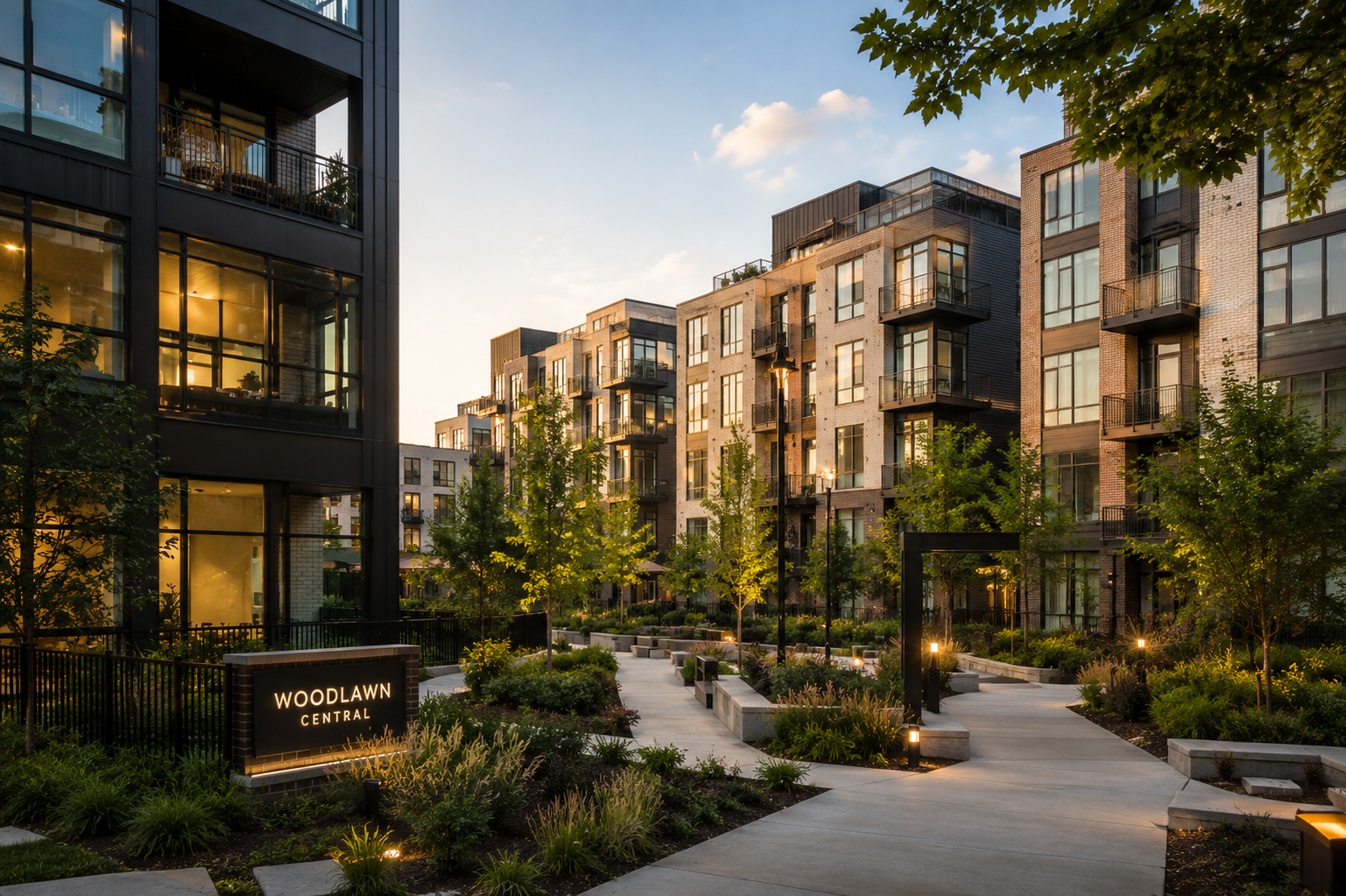
Woodlawn Central is not a community development center with an economic add-on. It is an integrated strategy that treats homeownership pathways, local hiring, minority business development, and community land trust models as parts of the same engine, all designed to stabilize and grow Woodlawn’s place in the Chicago housing market from the inside out.
At the heart of the project is a vision for inclusive growth, featuring diverse commercial spaces, a 154-room hotel, a black box theater, a vertical greenhouse, and a microgrid energy facility.
Every element, from retail and hospitality to culture, tech, and transit, has been thoughtfully crafted to champion Black-owned businesses and bring substantial employment opportunities directly to Southside residents, ensuring that the people of this community are the first to benefit from this transformative development.
This is what it looks like to take on Chicago housing inequality and real estate development on our own terms. We’re not waiting for the market to discover Woodlawn, we’re building the foundation that makes the Southside’s future work for the people who have always known what this neighborhood is worth.
Why Every Neighborhood Needs a Community Development Center
True community development centers require discipline, alignment, and education. It requires participation that evolves into contribution, and contribution that builds toward ownership. The goal is not just to live in Southside communities. It is to build and sustain them.
We are not providing the foundational education in ownership, real estate development sequencing, policy, and economics that Black communities require to navigate the Chicago housing market. And until we do, the cycle repeats.
The world is building the future while too many of us are still arguing about the present. Housing affordability doesn’t get solved by opposition. It gets solved by organized, educated communities that understand the system and show up prepared to shape it.
If we want different outcomes, we must become different participants in the process, moving from reaction to strategy, from noise to structure, and from presence to contribution.
Woodlawn is not waiting. The build has begun.
Explore the latest news, community highlights, development updates, and impactful stories shaping the future of Woodlawn Central and Chicago’s South Side.

Woodlawn's News & Announcements

connect
South Side Soundtrack
Our Community ● Our Community ● Our Community ● Our Community ● Our Community ● Our Community ● Our Community ● Our Community ● Our Community ●


